
How AI is Changing App Development - Three Phases
According to a survey by secondtalent, 41% of the code written in 2025 was AI-generated or AI-supported, and 71% of developers use AI coding tools.
At Appvision 2026, I took a look at how app development is fundamentally changing and how that impacts roles and responsibilities of app developers.
Table of Contents
Three Phases of AI-supported App Development
We are observing seeing phases of AI supported app development:
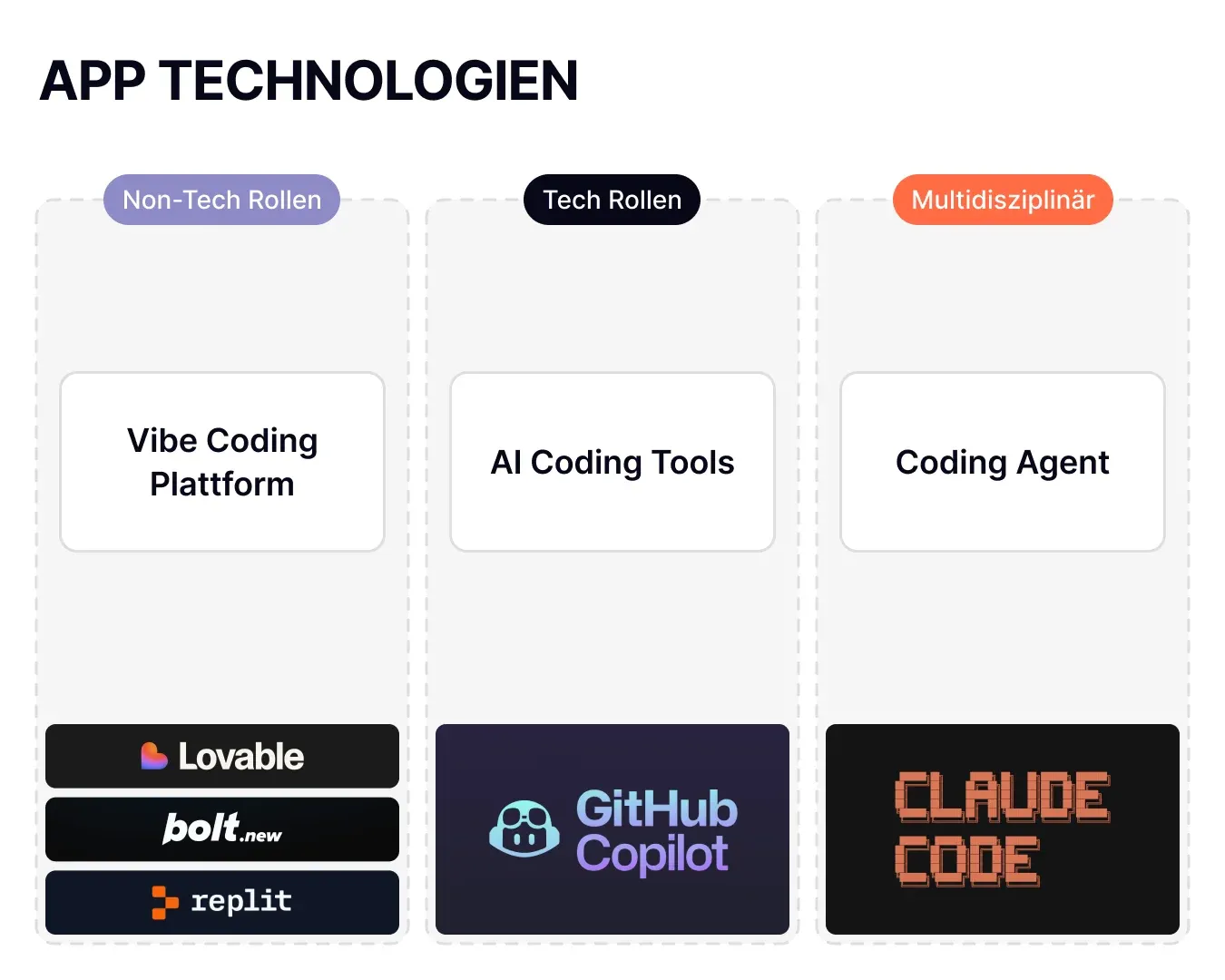
Phase 1: Vibe Coding Platforms
Vibe coding platforms like Lovable or Replit transform natural language directly into apps. This is a real paradigm shift compared to classic no-code builders. While builders cover reproducible standard applications like restaurant apps or hairdresser apps, vibe coding platforms enable true custom development via natural language. Business requirements and not a fixed template determine the app development process.
Where are the limits? Currently, they still lie in deployment, maintainability over several years, and more complex system architectures consisting of multiple components. If you need an internal tool app or a quick prototype, vibe coding platforms are a very good option. If you are however looking to develop an app that will still run securely in a live environment for several years, you will quickly hit the boundaries of vibe voding platforms.
Vibe coding tool are ideal for: Prototypes, internal tools, clarifying requirements, non-technical users.
Phase 2: AI Coding Assitants
Cursor, GitHub Copilot, and other coding assistants are designed for developers and act as co-programmers that are directly embedded in the development environment. The code they write remains visible and editable. The coding assistant can interpret it, make suggestions, create technical plans, and answer questions.
This is how we work today at Hybrid Heroes. The efficiency gains are significant and so are new areas of oversight and QC that are required: AI generated code must still be well understood, checked, and accounted for. AI coding doesn't mean shifting to auto-pilot.
AI coding assistants are ideal for: Technical experts and app developers looking to produce efficienct code.
Phase 3: AI Coding Agents
Tools like Claude Code go one step further: they take tasks over autonomously and can work on multiple assignments in parallel. You present a programming task, and the agent processes it—including follow-up questions that don't always just revolve around technical details. Should the button go here or there? Which UX pattern fits better?
This is exactly where a question arises to which we do not yet have a definitive answer: Who controls the AI coding agent?
Is this a new job profile? A Product Engineer who overseas and owns design, technology, and product management? Or is a multidisciplinary team cooperating on this task? Or are agents primarily suitable for clearly defined subtasks rather than for entire product development processes?
We expect some more clarity on this question in the near feature, but ultimately, it is a critical question that may shape app development team job scopes and roles for years to come.
How to Prepare Your Development Team for the Age of AI
Based on the three phases outlined this blog post I have derived three recommendations:
Decouple prototyping from engineering. Non-technical roles—Product, Design, Business, Sales, Marketing—can and should build prototypes themselves. The tools for this are available, and everyone should acquire the skills to use them.
Use prototypes as requirements documents. App development is a visual field. A functioning prototype makes requirements clearer than any specifications document or Jira ticket. Handing over requirements with a well thought out prototype significantly reduces misunderstandings and cuts iteration loops.
Define AI standards early. Code style, review processes and deliverable ownership—all of these must also be established in the context of AI-generated code. Whoever defines these standards early on will be able to deploy a stable framework that remains relevant as AI tools become faster and more powerful.
Navigate the AI Conding Transition and Hedge Your Bets
Development workflows are evolving fast and AI is disrupting software engineering at lightning speed. But core principle remain unchanged: Good apps are created when people ask the right questions and use the right tools.
You can find the full Appvision 2026 talk on this topic here:
https://www.youtube.com/watch?v=tvMHLwUxVL0
Jan Gerwin is the founder and CEO of Hybrid Heroes. Hybrid Heroes has been developing, designing, and maintaining apps for businesses and organizations for over 10 years.