Hard Paywall vs. Freemium: What the RevenueCat Data Really Means
| Which model converts better — hard paywall or freemium? | When is freemium still the right choice? |
|---|---|
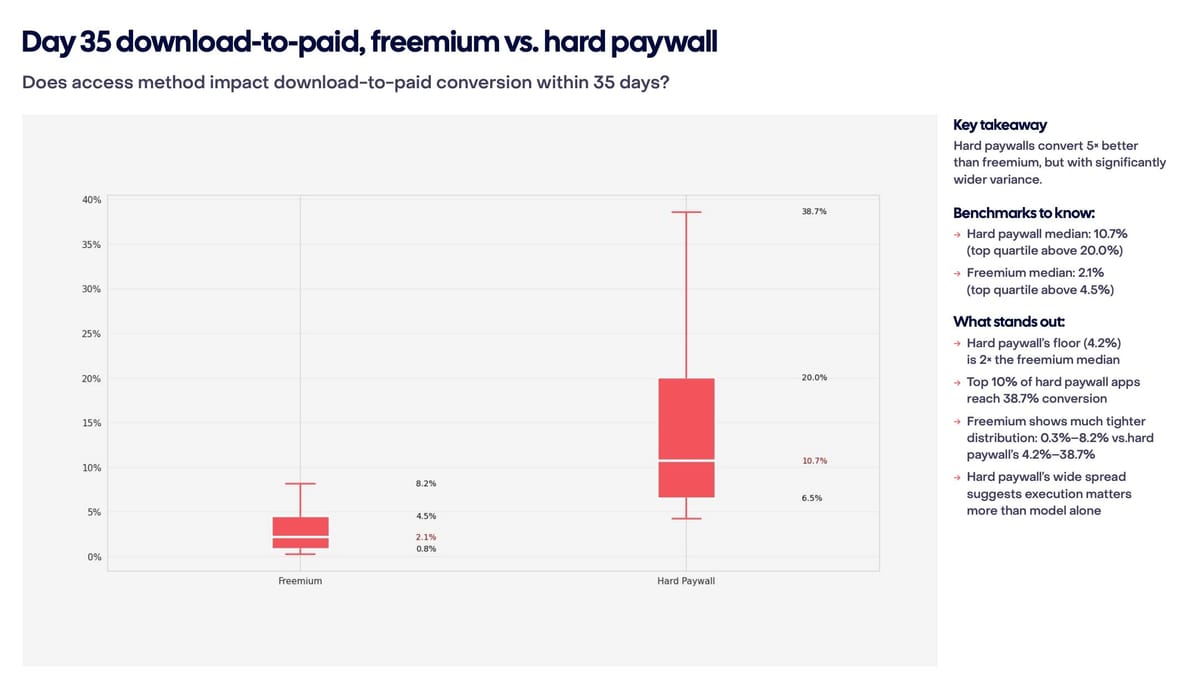
| Hard paywalls achieve a download-to-paid rate of 10.7% after 35 days, vs. 2.1% for freemium. That’s a 5x difference. | When your app lives on network effects, or when reach and brand building are your primary goals. |
| What does the 55% trial cancellation stat mean for my product? | What is the main requirement for a hard paywall to be successful? |
|---|---|
| 55% of all 3-day trials are cancelled on day one. The first session decides — not the trial period. | The app's core value must be immediately obvious to the user, ideally in under 90 seconds. |
Hard paywalls convert five times better than freemium models. That’s the headline from the latest RevenueCat State of Subscription Report — one of the largest real-world datasets on subscription apps. Does that mean everyone should switch immediately? Not necessarily. But it does mean most product teams need to rethink their monetization strategy.
Table of Contents
The number that changes everything
10.7% vs. 2.1%. That is not a small difference — it’s a factor of five.
If you build or own subscription apps, you can’t ignore this. The RevenueCat dataset covers millions of real transactions across live subscription apps worldwide.
What makes it even more interesting: after 12 months, retention is nearly identical across both models. Users who convert through a hard paywall are just as loyal as freemium converters. The gap is entirely in the conversion step itself.
Freemium wins more downloads. But it converts only a fraction of them into revenue. Hard paywalls filter early: whoever pays is committed.
Hard paywall: When it works
A hard paywall means: no access without payment or a trial. That sounds aggressive — but the data shows it works extremely well when one condition is met:
The value of your app must be felt immediately.
Not after three days. Not after an onboarding flow. In the very first session.
Which apps benefit?
- Productivity and focus apps (calendars, task managers, note-taking)
- Health & fitness apps with a clear routine-driven logic
- Learning apps with a structured curriculum
- Single-purpose tools: PDF scanners, password managers, trackers
Best for: Apps where new users understand within 90 seconds why they should pay.
Revenue predictability as a strategic advantage
For teams planning UA (user acquisition) budgets, hard paywalls are easier to model. ROI per download can be measured earlier — because conversion happens earlier.
Especially in enterprise contexts where business cases need to be stable, this is a genuine edge.
Freemium: When it’s the right call
A low conversion rate doesn’t automatically mean freemium is wrong. There are two scenarios where freemium is strategically superior.
Network effects as a growth engine
Messaging apps, collaborative tools, social features — here, the mass of users is the product itself. The more people use the app, the more valuable it becomes for everyone.
A hard paywall would kill exactly the network effect that creates the value proposition in the first place.
Best for: Apps that get better the more people use them.
Long-term brand building
Some digital products are strategically designed as brand assets — tools that sit within a larger ecosystem, for instance. Here, reach matters more than short-term revenue. Freemium drives organic growth, word-of-mouth, and brand awareness.
Best for: Apps where reach and brand recognition are the primary KPIs.
The insight that surprised me most: 55% cancel on day one
This stat holds regardless of your monetization model — and it changes how we need to think about onboarding:
The vast majority of your potential customers make their decision in the very first session. Not after three days. Not after an onboarding flow. Immediately.
The classic assumption “we’ll give users three days to get to know the app” simply doesn’t hold. The decision happens far earlier — and teams that ignore this are burning UA budget.
What this means in practice
- The aha moment belongs in the first session — not after 48 hours
- Onboarding must deliver value, not just information
- Push notifications after day one come too late for 55% of users
- A/B tests on the first-session experience have the highest possible lever
Hard paywall vs. freemium: Side by side
Which model fits your app?
Instead of blanket recommendations, four questions that lead you to the right decision:
- Can a new user experience the core value in under 90 seconds? → Yes: consider a hard paywall.
- Does your product become more valuable with more users? → Yes: freemium as a growth engine.
- Is reach more important than short-term revenue? → Yes: freemium for brand building.
- Do you need to predict revenue early? → Yes: hard paywall — higher predictability.
Neither model is inherently superior. It’s not about what competitors do — it’s about what your product can deliver in the first session.
Takeaway: It’s not the model that decides — it’s the first session
The RevenueCat report is a wake-up call. Three things I take from it for our work:
- Hard paywalls convert 5x better — when users see the value immediately.
- Freemium is the right call for network effects or reach-first strategies.
- The first session is the most important product asset you have — in any model.
For CTOs and PMs, this means: monetization strategy isn’t a marketing decision. It’s an engineering and design decision that must be visible in the first session.
Get in touch → hybridheroes.de/contact